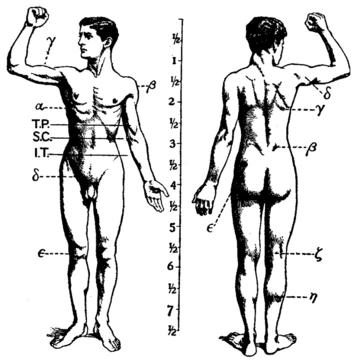
Skeletal muscle
Striated, multinucleated tissue enabling voluntary movement and posture.

Skeletal muscle is one of the three types of vertebrate muscle tissue, the others being cardiac muscle and smooth muscle. It is part of the musculoskeletal system and is typically attached by tendons to the bones of a skeleton. Skeletal muscle comprises about 35% of the human body by weight and is responsible for producing movement, maintaining body posture, controlling body temperature, and stabilizing joints. It also functions as an endocrine organ, secreting a variety of proteins, lipids, amino acids, metabolites, and small RNAs.
- field
- Anatomy, Physiology
- known_for
- Voluntary movement, striated appearance, multinucleated muscle fibers
- percentage_of_body_weight
- ~35% in humans
- percentage_of_body_weight_in_healthy_you
- Around 40%
Lore & Background
Skeletal muscle cells, also called muscle fibers, are much longer than those in other muscle types and are formed from the fusion of developmental myoblasts during myogenesis, resulting in long multinucleated cells. The nuclei, termed myonuclei, are located along the inside of the cell membrane. Each muscle fiber contains myofibrils composed of actin and myosin filaments repeated in units called sarcomeres, which are the basic functional contractile units necessary for muscle contraction. Muscles are predominantly powered by the oxidation of fats and carbohydrates, though anaerobic reactions are also used, particularly by fast twitch fibers, to produce ATP for myosin head movement. A skeletal muscle contains multiple fascicles—bundles of muscle fibers—each surrounded by connective tissue layers of fascia. Muscles attach to tendons at the myotendinous junction, a specialized interface for force transmission. Sensory receptors such as muscle spindles and Golgi tendon organs are found within muscles, providing stretch and tension information.
Reader's Guide
Skeletal muscle is fundamental to vertebrate locomotion and homeostasis. Its striated appearance, due to the regular arrangement of sarcomeres, distinguishes it from smooth and cardiac muscle. The multinucleated nature of its fibers, arising from myoblast fusion, allows for the production of large amounts of proteins and enzymes needed for contraction and repair. The presence of satellite cells provides a regenerative capacity, while the diverse mononuclear cell population—including endothelial cells, fibro-adipogenic progenitors, pericytes, and immune cells—highlights the tissue's complexity beyond just contractile function. Skeletal muscle's role as an endocrine organ, secreting hundreds of different proteins and other molecules, underscores its systemic influence on metabolism and physiology. The architectural arrangement of fibers into parallel or pennate configurations affects force generation and speed of contraction. Understanding skeletal muscle is critical for fields ranging from sports science to medicine, as it impacts movement, metabolic health, and aging. The detailed knowledge of its cellular composition and signaling pathways continues to inform research on muscle diseases, regeneration, and the effects of exercise.
Did You Know?
- Skeletal muscle comprises about 35% of the human body by weight.
- A single muscle fiber can contain from hundreds to thousands of nuclei.
- In terms of nuclei present in skeletal muscle, myocyte nuclei may be only half of the nuclei present, with the other half from resident and infiltrating mononuclear cells.
- Muscle fibers are formed from the fusion of developmental myoblasts in a process known as myogenesis.
The Architecture of Voluntary Motion
Skeletal muscles are the only muscles in the body capable of moving the body through conscious effort. Unlike cardiac and smooth muscles, which operate without voluntary control, skeletal muscles are anchored to bones and organized into opposing groups around joints. This arrangement is no accident: the system is engineered so that when a muscle contracts and pulls on a bone, the joint stays properly aligned, and that alignment in turn preserves the correct length and tension in the muscle itself. Cartilage sits between bone ends to prevent direct rubbing, while tendons and ligaments serve as the connective tissue that links muscle fibers to the rigid skeletal framework. Together, these components create a harmonious interaction where applied muscular force keeps joints positioned correctly during movement, and the joint's stability reciprocally supports the muscle's mechanical integrity. The result is a body capable of form, support, stability, and purposeful motion.
From Nerve Signal to Contraction
The journey from a thought to a physical movement begins at the neuromuscular junction. A motor neuron in the somatic nervous system fires, and depolarization of that neuron triggers the release of neurotransmitters from its terminal. These chemical messengers drift across the tiny gap—the synapse—between the nerve ending and the muscle fiber's cell membrane. Once they latch onto specific receptor sites, a threshold is reached and an action potential is generated. The permeability of the sarcolemma shifts, and the muscle fiber is primed to contract. This entire sequence, known as initiation, is the gateway through which electrical signals from the central nervous system are translated into mechanical force. Without this precise chain of events, the skeletal muscle would remain inert, and the body would be unable to shift position or perform any voluntary action.
Tendons as Spring-Like Force Transmitters
A tendon is a tough yet flexible band of fibrous connective tissue that serves as the critical bridge between muscle and bone. At both the distal and proximal ends of a muscle, the extracellular connective tissue that binds individual muscle fibers together transitions into the tendon. The tendon then anchors itself to the periosteum of the bone at the muscle's origin and insertion points. When the muscle contracts, it is the tendon that transmits the generated force to the relatively rigid bone, pulling on it and producing movement. What makes tendons particularly remarkable is their capacity to stretch substantially under load. This elasticity allows them to function as biological springs, absorbing and returning energy during repetitive motions. In this way, tendons are not merely passive connectors but active participants in the mechanics of locomotion, converting muscular contraction into the smooth, efficient movement of the skeleton.
The Skeletal Stage on Which Muscles Perform
Skeletal muscles do not work in isolation; they depend entirely on the bony framework to which they attach. The adult human skeleton, composed of 206 bones after many of the 300-plus bones present at birth have fused, is divided into the axial skeleton—anchored by the vertebral column—and the appendicular skeleton. These bones provide the stability and shape that muscles need as leverage points. Beyond structural support, the skeleton houses two types of bone marrow: yellow marrow, a fatty tissue in the marrow cavity that the body can tap for energy during starvation, and red marrow, which produces roughly 2.6 million red blood cells per second along with platelets and most leukocytes. Bones also act as a mineral reservoir, storing calcium and phosphorus and releasing them to regulate blood levels. This multifunctional framework—protection, blood production, mineral balance, and mechanical support—creates the indispensable stage on which skeletal muscles perform their role of movement.
Frequently Asked Questions
What is Skeletal muscle?
Skeletal muscle is a striated, multinucleated tissue that anchors to bones through tendons, making it the muscle type behind every voluntary movement you make. It sits alongside cardiac and smooth muscle as one of the three vertebrate muscle tissue categories.
What are Skeletal muscle's main roles in the body?
Beyond driving voluntary movement, Skeletal muscle holds posture upright, stabilizes joints, helps regulate temperature, and even functions as an endocrine organ by secreting proteins, lipids, amino acids, and small RNAs into circulation.
How much of the human body is made up of Skeletal muscle?
It represents roughly 35% of total adult body weight, rising to about 40% in a healthy young individual. That makes it the single largest tissue mass in the human body by weight.
What sets Skeletal muscle apart from cardiac and smooth muscle?
Its defining traits are the visible striated banding pattern, the multinucleated structure of each fiber, and the fact that it operates under conscious voluntary control rather than autonomously.
Why is Skeletal muscle considered essential to the musculoskeletal system?
Without it, the skeletal framework would be immobile—no locomotion, no maintained posture, and no joint stabilization would be possible. It is the primary engine that gives the entire skeleton its functional purpose.
More in Musculoskeletal System 25-28
Elsewhere in the Musculoskeletal System universe
Spotted an error? Know more?
This is a living reference — every entry is fact-audited, and reader corrections feed straight into our audit queue. Suggest an edit · See this site's audit record