Spinal column
The defining structure of all vertebrates, protecting the spinal cord.

The spinal column, also known as the vertebral column, spine or backbone, is the core part of the axial skeleton in vertebrates. It is the defining and eponymous characteristic of the vertebrate, consisting of a segmented column of vertebrae that surrounds and protects the spinal cord. The human spine is one of the most-studied examples, with a structure typical of that found in other mammals, reptiles, and birds.
- Number of vertebrae in humans
- 33 (normally)
- Cervical vertebrae
- 7
- Thoracic vertebrae
- 12
- Lumbar vertebrae
- 5
- Sacral vertebrae
- 5 (fused)
- Coccygeal vertebrae
- 4 (3–5, fused)
Lore & Background
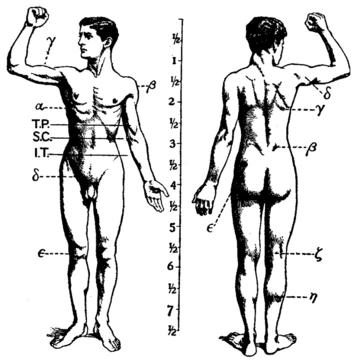
The spinal column is a segmented column of vertebrae separated by intervertebral discs in a series of cartilaginous joints. The dorsal portion houses the spinal canal, an elongated cavity formed by the alignment of vertebral neural arches that encloses and protects the spinal cord, with spinal nerves exiting via the intervertebral foramina. Individual vertebrae are named according to their corresponding region including the neck, thorax, abdomen, pelvis or tail. In clinical medicine, features such as the spinous process can be used as surface landmarks to guide procedures like lumbar punctures and spinal anesthesia.
Reader's Guide
The spinal column is central to vertebrate anatomy and evolution, providing structural support, protection for the spinal cord, and flexibility for movement. Its segmented nature allows for regional specialization: cervical vertebrae support the head, thoracic vertebrae articulate with ribs, lumbar vertebrae bear much of the body's weight, and the fused sacrum and coccyx form the pelvic base. The column's curvatures—cervical and lumbar lordotic curves, thoracic and sacral kyphotic curves—increase strength and shock absorption, adapting to bipedal posture. Variations in vertebral number occur in about 10% of people, with deviations such as 11 or 13 thoracic vertebrae or 4 or 6 lumbar vertebrae. Spinal diseases like kyphosis, scoliosis, ankylosing spondylitis, and degenerative discs affect the vertebrae and intervertebral discs, while spina bifida is the most common birth defect of the spinal column. The column's ligaments, including the anterior and posterior longitudinal ligaments and ligamentum flavum, provide stability. The cauda equina, a bundle of spinal nerves, occupies the lower spinal canal in adults, as the spinal cord ends around the upper lumbar spine.
Did You Know?
- In humans, the spinal cord often ends at the upper lumbar spine (around L1/L2) in adults, with the cauda equina below.
- The cervical curve forms when an infant can hold up its head at three or four months and sit upright at nine months.
- Spina bifida is the most common birth defect affecting the spinal column.
Foundation of the Axial Framework
The spinal column occupies a central place within the axial skeleton, one of two major divisions of the human skeletal structure. The axial skeleton provides the core shape and form for the body, serving as the primary framework to which tissues and organs attach themselves. As part of this foundational structure, the vertebral column contributes to the overall stability and support that the musculoskeletal system delivers. The skeleton as a whole is composed of both fused and individual bones held together by ligaments, tendons, muscles, and cartilage. At birth, humans possess over 300 bones, but many of these fuse together as the body matures, resulting in the approximately 206 bones found in an average adult. The spinal column, as a key component of the axial division, participates in this complex architecture of interconnected structures that give the body its form and enable it to maintain an upright, functional posture.
Guardian of Vital Structures and Mineral Reserves
Beyond its structural role, the spinal column participates in the protective and metabolic functions of the skeletal system. The skeleton acts as a shield for vital organs—much as the skull guards the brain and the rib cage encloses the lungs, the vertebral column safeguards critical internal structures. Additionally, the bones that make up this system serve as the body's principal reservoir for calcium and phosphorus. When mineral levels in the bloodstream fluctuate, excess amounts are deposited into bone tissue, while depleted levels trigger the release of stored minerals back into circulation. Within the longer bones of the skeleton, red marrow continuously generates approximately 2.6 million red blood cells each second, replacing those destroyed by the liver. All erythrocytes, platelets, and most leukocytes in an adult originate in this red marrow before migrating into the bloodstream to perform their specialized roles.
The Mechanics of Motion and Connection
The spinal column does not operate in isolation; it is embedded within a network of connective tissues that coordinate movement throughout the body. Tendons—tough, flexible bands of fibrous connective tissue—link muscles to bones, binding to the periosteum at each muscle's origin and insertion points. When a muscle contracts, the tendon transmits that force to the relatively rigid bone, producing motion. Cartilage plays a crucial intermediary role at joints, preventing the ends of bones from grinding directly against one another. The joints and muscles are engineered to work in harmony: any muscular force applied keeps the joint properly positioned and aligned during movement, which in turn helps maintain the correct length and tension in the corresponding muscles. This reciprocal relationship ensures that the spinal column and surrounding structures move as a unified, coordinated system rather than as independent parts.
When the System Fails: Diagnosis and Care
Despite the remarkable design of the musculoskeletal system, diseases and disorders can impair its function and overall effectiveness. These conditions present particular diagnostic challenges because the musculoskeletal system is closely intertwined with other internal systems, making it difficult to isolate the source of a problem. Complex injuries and ailments affecting the spinal column and surrounding structures typically fall under the care of specialized medical professionals. A physiatrist, who focuses on physical medicine and rehabilitation, or an orthopaedic surgeon, may be called upon to manage these cases. The close relationship between the skeletal framework, the muscular system, and internal organ systems means that a single complaint can have far-reaching implications, requiring a thorough understanding of how bones, muscles, cartilage, tendons, ligaments, and joints interact to maintain the body's form, support, and mobility.
Frequently Asked Questions
Who is Spinal column?
Spinal column is the central bony pillar running through the axial skeleton of every vertebrate, built from a stacked series of individual bones called vertebrae. It is the single feature that literally gives the entire vertebrate lineage its name.
What is Spinal column's role in the body?
Its core job is to encase and shield the spinal cord while simultaneously serving as the main structural axis for the torso. It also anchors ribs, muscles, and limb girdles, making upright posture and locomotion possible.
How many individual 'members' make up Spinal column in a human?
A typical human spine contains 33 vertebrae split across five regions: seven cervical, twelve thoracic, five lumbar, five sacral, and four coccygeal. The sacral and coccygeal segments are fused, so they function as a single rigid unit rather than separate movable pieces.
Why is Spinal column considered the defining trait of all vertebrates?
It is the one anatomical structure that separates vertebrates from every other animal group, since the very word 'vertebrate' is derived from the vertebrae that build this column. Without this segmented bony core, the classification simply would not exist.
What happens at the 'end' of Spinal column's structure?
The final segments—five sacral and roughly four coccygeal vertebrae—fuse into solid bone, losing their individual mobility to form the sacrum and coccyx. This gives the lower end a stable, rigid base rather than continuing as a chain of freely moving pieces.
More in Musculoskeletal System 1-24
Elsewhere in the Musculoskeletal System universe
Spotted an error? Know more?
This is a living reference — every entry is fact-audited, and reader corrections feed straight into our audit queue. Suggest an edit · See this site's audit record