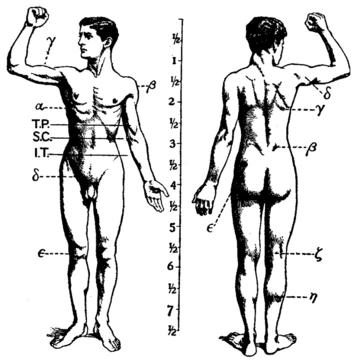
Deltoid muscle
Muscle forming the rounded contour of the human shoulder.

The deltoid muscle (musculus deltoideus) is the muscle forming the rounded contour of the human shoulder. It is also known as the 'common shoulder muscle', particularly in other animals such as the domestic cat. Anatomically, the deltoid muscle is made up of three distinct sets of muscle fibers: the anterior or clavicular part, the posterior or scapular part, and the intermediate or acromial part. Its fibers are pennate muscle, though electromyography suggests it consists of at least seven groups that can be independently coordinated by the nervous system.
- nerve supply
- axillary nerve (from C5 and C6)
- blood supply
- thoracoacromial artery, circumflex humeral arteries, profunda brachii artery
- origin
- clavicle, acromion process, spine of scapula
- insertion
- deltoid tuberosity on the humerus
Lore & Background
The deltoid muscle was previously called the deltoideus, and the name is still used by some anatomists. It is called so because it is in the shape of the Greek capital letter delta (Δ). Deltoid is also further shortened in slang as 'delt'.
Reader's Guide
The deltoid muscle is significant as the prime mover of arm abduction along the frontal plane when all its fibers contract simultaneously. It prevents dislocation of the humeral head when carrying heavy loads and ensures precise movement of the glenohumeral joint. The deltoid is innervated by the axillary nerve, which can be damaged during surgical procedures of the axilla or by anterior dislocation of the humeral head. Clinically, the most common abnormalities affecting the deltoid are tears, fatty atrophy, and enthesopathy. Intramuscular injections are commonly given in the lower half of the deltoid to avoid injury to the axillary nerve. In other animals, the deltoid is found in great apes; in common chimpanzees it is much larger than in humans, reflecting the need to strengthen the shoulders for knuckle walking.
Did You Know?
- The deltoid muscle is named for its shape resembling the Greek capital letter delta (Δ).
- Electromyography suggests the deltoid consists of at least seven neuromuscular groups that can be independently coordinated.
- The deltoid is innervated by the axillary nerve, which originates from cervical nerves C5 and C6.
Frequently Asked Questions
Who is Deltoid muscle?
The deltoid is the thick, dome-shaped muscle that carves out the rounded silhouette of the human shoulder. In veterinary anatomy it is often simply called the 'common shoulder muscle,' a label seen in species like the domestic cat.
What are Deltoid muscle's powers/role?
It drives the major sweeping motions of the arm—abduction, flexion, and extension—by splitting its work across three fiber groups: the anterior (clavicular), posterior (scapular), and intermediate (acromial) portions. Electromyography research hints the muscle actually contains at least seven independently coordinable subgroups, giving it finer control than its three-part name suggests.
How does Deltoid muscle's story end?
Every fiber, regardless of which of the three origins it started from (clavicle, acromion, or scapular spine), converges and anchors into the deltoid tuberosity on the humerus. That insertion is the final beat of its mechanical narrative, where all its pulling force is handed off to the bone.
Why is Deltoid muscle important?
It is the primary muscle responsible for lifting the arm away from the body and shaping the shoulder's visible contour, making it both a functional workhorse and a key aesthetic landmark. Loss of its axillary-nerve (C5–C6) supply would leave the shoulder flat and the arm nearly unable to abduct.
What's Deltoid muscle's support crew?
Its blood arrives via the thoracoacromial artery, the circumflex humeral arteries, and the profunda brachii artery, while the axillary nerve (C5–C6) carries all motor commands. This combined vascular and neural infrastructure is what lets the muscle fire its pennate fibers in the precise sequences needed for everyday arm movement.
More in Musculoskeletal System 1-24
Elsewhere in the Musculoskeletal System universe
Spotted an error? Know more?
This is a living reference — every entry is fact-audited, and reader corrections feed straight into our audit queue. Suggest an edit · See this site's audit record