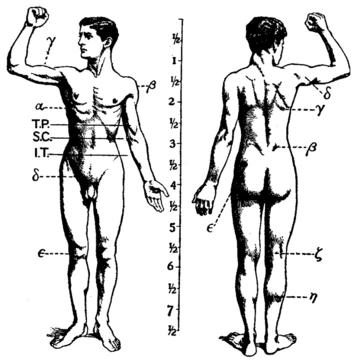
Groin
Junctional area between torso and thigh, site of adductor muscles.

The groin, also known as the inguinal region or iliac region, is the junctional area between the torso and the thigh in human anatomy. It is located at the front of the body on either side of the pubic tubercle, where the lower part of the abdominal wall meets the thigh, forming a crease called the inguinal groove.
- field
- Human anatomy
- known_for
- Junctional area between torso and thigh; site of groin muscles, inguinal lymph nodes, and inguinal hernias
- location
- Front of body, on either side of pubic tubercle
- components
- Adductor muscles (adductor brevis, adductor longus, adductor magnus, gracilis, pectineus), inguinal ligament, deep and superficial inguinal lymph nodes, lateral and medial inguinal fossae
Lore & Background
The groin contains the attachments of the adductor muscles of the hip, known as the groin muscles, which include the adductor brevis, adductor longus, adductor magnus, gracilis, and pectineus. These muscles adduct the thigh, bringing the thigh and knee closer to the midline. The groin is innervated by branches of the lumbar plexus, with the pectineus innervated by the femoral nerve and the hamstring portion of adductor magnus by the tibial nerve.
Reader's Guide
The groin is clinically significant as the site of common injuries and conditions. A pulled groin muscle usually refers to a painful strain of the hip adductor muscles, related to risk factors including overuse and previous injury. Inguinal hernias occur in the groin and can be direct or indirect, sometimes presenting together as a saddlebag hernia. The groin is also an area where blood vessels and nerves pass relatively superficially, with an increased amount of lymph nodes, and in venography it is the preferred site for incisions to enter a catheter into the vascular system. The inguinal ligament, running from the pubic tubercle to the anterior superior iliac spine, is important for hernia operations.
Did You Know?
- The groin contains three to five deep inguinal lymph nodes that play a role in the immune system.
- A 'groin pull' involves a strain of the leg adductor muscle group in the inguinal area.
- The inguinal ligament runs from the pubic tubercle to the anterior superior iliac spine.
- In a venography procedure, the groin is the preferred site for incisions to enter a catheter into the vascular system.
Frequently Asked Questions
What is the Groin in the musculoskeletal system?
The Groin, also called the inguinal or iliac region, is the transitional zone where the lower abdominal wall connects to the upper thigh. It sits at the front of the body on both sides of the pubic tubercle, marked by a visible crease known as the inguinal groove.
Where exactly is the Groin located?
It occupies the junction between the torso and the thigh, positioned on either side of the pubic tubercle at the front of the body. The lower abdominal wall meets the thigh here, creating the characteristic inguinal groove.
Which muscles are part of the Groin region?
The adductor muscle group—comprising the adductor brevis, adductor longus, adductor magnus, gracilis, and pectineus—anchors in this area. The inguinal ligament also forms a key structural component of the region.
Why is the Groin a common site for hernias?
The junction between the abdominal wall and the thigh creates a natural weak point where internal structures can protrude outward. This is why inguinal hernias are among the most frequently encountered types of hernia in clinical practice.
What other important structures reside in the Groin?
Beyond the adductor muscles, the region houses both deep and superficial inguinal lymph nodes, which serve as drainage points for the lower limbs and external genitalia. The lateral and medial inguinal fossae are also anatomical landmarks found here.
More in Musculoskeletal System 1-24
Elsewhere in the Musculoskeletal System universe
Spotted an error? Know more?
This is a living reference — every entry is fact-audited, and reader corrections feed straight into our audit queue. Suggest an edit · See this site's audit record